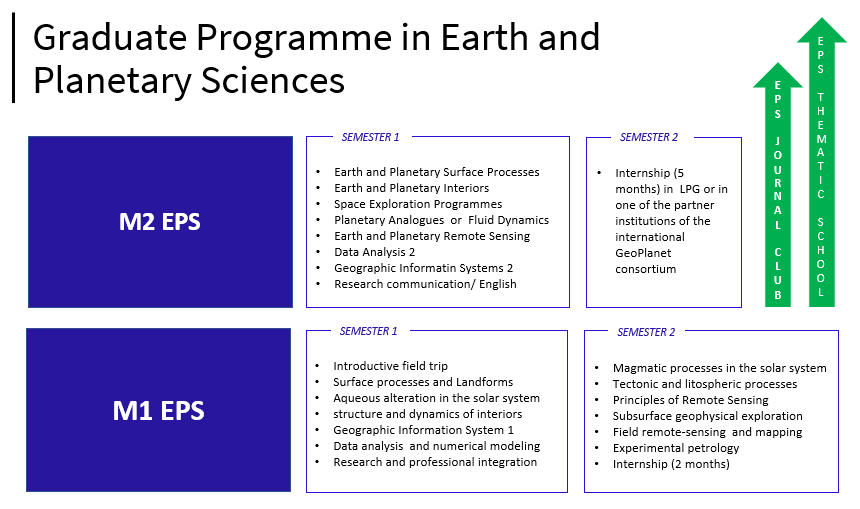
 Our programme in Earth and Planetary Sciences (EPS), affiliated with the Master's in Earth, Planetary and Environmental Sciences, aims to train the next generation of geologists, planetologists and space exploration mission experts by offering a cutting-edge teaching programme and the opportunity to study in an international environment. This course will offer you a unique learning experience combining a theoretical approach, field experience and project-based teaching at the Laboratoire de Planétologie et Géosciences (LPG). The LPG is involved in space exploration programmes as a member of the international research and training consortium GeoPlaNet, comprising more than 20 institutional research partners worldwide. Throughout your studies, you will work with students and researchers from different countries and be introduced to the major international programmes of NASA and ESA.
Through our multidisciplinary approach, which draws on the latest knowledge in geosciences and planetary sciences, you will acquire cutting-edge knowledge and develop research skills from the Master's level onwards:
- Working in an international collaborative environment
- Analysing and interpreting multidisciplinary data using advanced techniques and digital tools.
- Communicating the latest advances in the field in a concise, academic manner.
Mastering these advanced techniques will give you a range of opportunities to pursue a career in academic or private entities linked to the geosciences and space exploration.
Why would you choose graduate programme Earth and Planetary Sciences ?
- A pedagogical team made up of geologists and planetologists from LPG involved in international space exploration programmes.
- Training through research, with individual research projects and participation in international teams.
- Field camps in the Cantal, the Alps and Groix (M1) and the Canary Islands (M2), and visits to the Synchrotron Soleil (M1) and the ESA in the Netherlands (M2) paid for by the course.
- Internship opportunities and funded research visits to partner institutions in the GeoPlaNet consortium around the world.
- Personalised coaching and mentoring to optimise your career plan in various fields of Earth and Planetary Sciences.
- Teaching entirely in English to prepare you for an international career.
They studied at EPS :
 Emeline, PhD student at the University of Groningen (Ne)
For me, the programme’s strengths were the numerous field placements we were able to take part in,
the fact that the Master’s is taught in English, and the opportunity to undertake a placement lasting several months abroad.
See full profile
 Léo, PhD student at LPG, France
This programme is ideal if you enjoy natural and ‘tangible’ sciences, fieldwork, working outdoors,
understand how the world around works, and what history the Earth can tell us about its own past
See full profile
 Camille, Geotechnical Engineer, Project Manager
What are the advantages of this programme? Classes are taught in English, it has an international dimension and
opens up opportunities for professional careers in several fields.
See full profile
What is a graduate programme ?
The Eart

h and Planetary Sciences (EPS) programme has been awarded the Graduate Programme (GP) label by Nantes Université and supported by the
Agence Nationale de la Recherche (ANR). This accreditation confirms that the programme draws on the research skills of
an internationally recognised laboratory and trains students in the
scientific approach and cutting-edge technologies. The skills acquired in accredited Masters programmes will enable you to successfully enter the world of business as an engineer, consultant or project manager in the R&D departments of major companies or in innovative SMEs. If you are interested in pursuing a
PhD programme, this Master's degree also offers you the best possible preparation, as the Master's teaching team is also responsible for organising doctorates in this field,into the
Graduate school 3MG.
Other contributing research units:


Scholarships :
You can apply for the
Eiffel Excellence Scholarship. The Eiffel Excellence Scholarship programme is designed for international students whose academic excellence has been recognised by the French higher education establishments that wish to host them for the continuation of their studies. Applications are usually received between October and November of the year preceding your arrival.
We also provide a 1500€ welcome grant based on excellence criteria.
In any case, we encourage you to consult your embassy to find out which scholarships you can apply for.