


- Recherche
Conférence : "Structural bioinformatics and AlphaFold modeling of the human kinome and its interactions" - Pr. Roland DUNBRACK (University of Pennsylvania)
-
Le 10 juin 2026 de 14:00 à 16:00false false
-
14h00, Amphi Pasteur (Bât.2)
Abstract : Protein kinases sit at the heart of cellular signaling, and their dysregulation drives many humandiseases. The human kinome comprises 480 genes containing one or more “typical” proteinkinase domains, comprising 437 catalytically active and 56 pseudokinase domains. In this talk, Iwill describe an integrated framework that combines structural bioinformatics of experimentalstructures with large-scale AlphaFold modeling to define, model, and interpret theconformational and interaction space of human protein kinases.
Leveraging a set of 54 unique substrate-bound kinase complexes, we derived structural criteria that define the active form of a protein kinase. Using these criteria, we modeled all 437 catalytically active human kinase domains in their active, substrate-competent conformations with AlphaFold2. We are using Boltz2 to extend this to ATP/Mg2+ bound and phosphorylated structures.
We applied AlphaFold2 modeling to all 480 full-length human proteins containing kinasedomains, identifying and naming folded domains across these multidomain proteins. Thisdomain-resolved view enables hypothesis generation for intramolecular autoinhibition, allostericcoupling, and partner recognition. Finally, I will present a new interaction-scoring approachbased on AlphaFold’s predicted aligned error (PAE) matrix (github.com/DunbrackLab/IPSAE)and show how it supports modeling of intra- and interprotein domain interactions of kinasesspanning activating, inhibiting, and substrate-binding assemblies.
Together, these advances provide a structurally grounded, proteome-scale platform for understanding kinase regulation and for guiding experiments and therapeutic discovery.
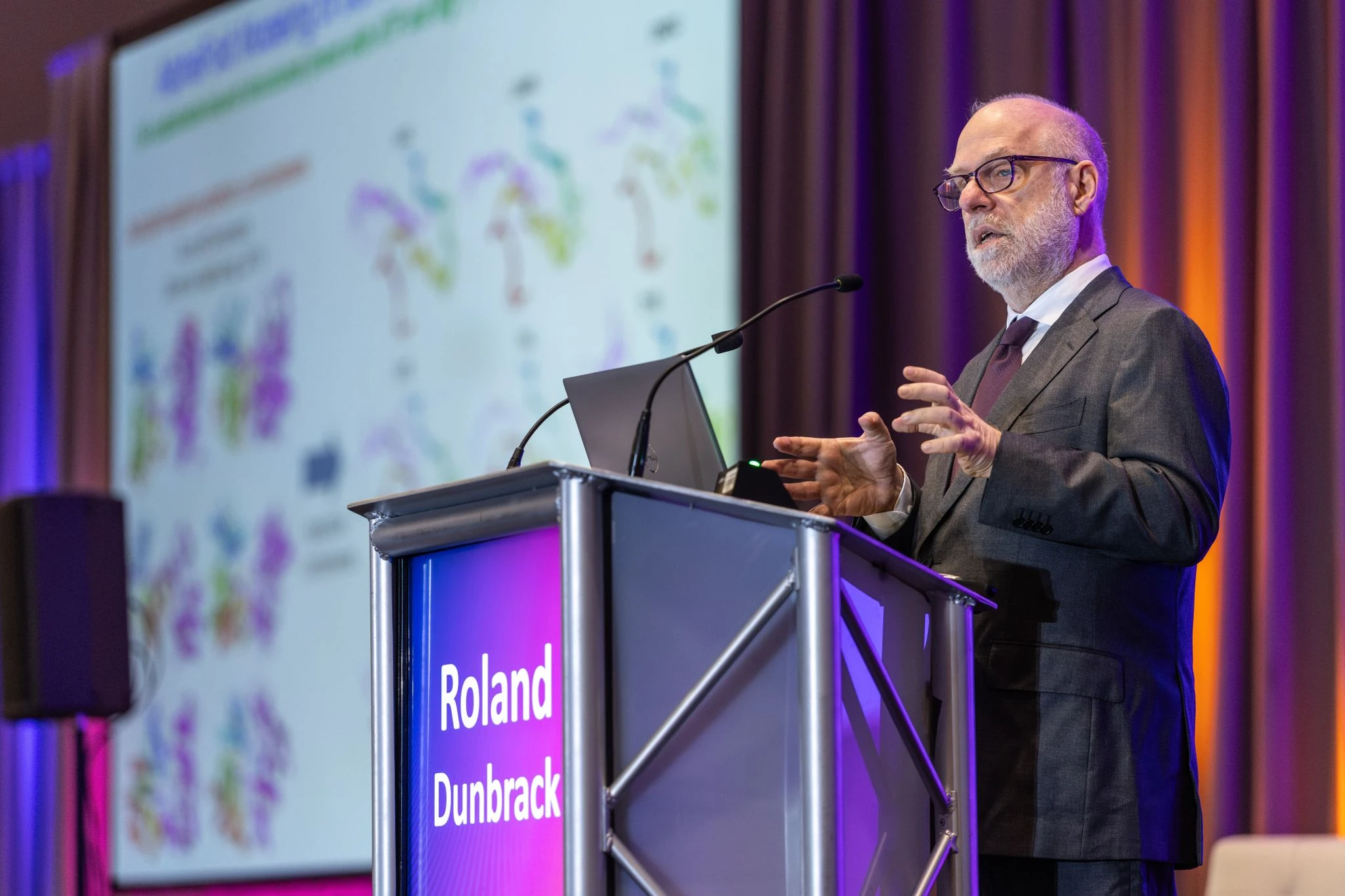
Dr. Dunbrack grew up in Massachusetts and received his AB in Chemistry in 1985 and PhD in biophysics in 1993 at Harvard University. After a postdoctoral fellowship at UCSF in 1997, he started his lab at Fox Chase Cancer Center where he has remained ever since. He has been active in the field of structural bioinformatics of proteins and protein complexes and the development of protein structure prediction methods. He has contributed extensively to scoring function and algorithms in the program Rosetta. At Fox Chase, he directs the Molecular Modeling Facility which works with colleagues across the Center to apply protein structure prediction to problems in cancer biology.